A career shaped by questions rather than credentials.
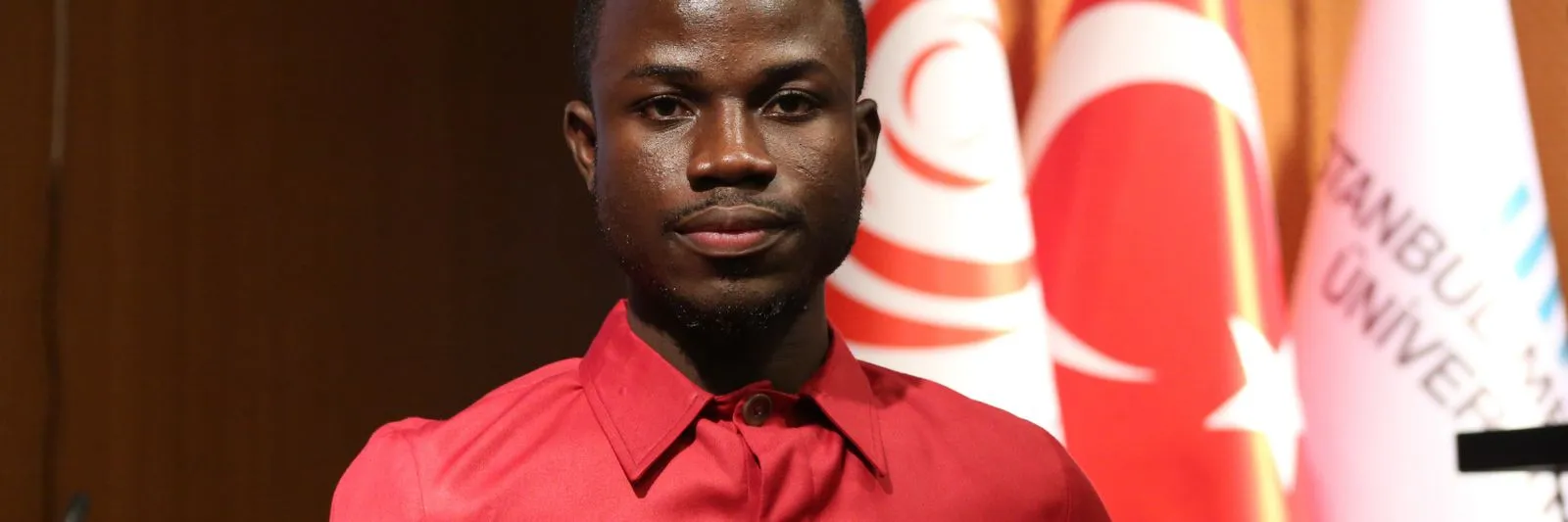
Faroukou Mintoiba is a Togolese author, researcher, and international development practitioner based in Istanbul, Türkiye. His work explores African politics, youth engagement, diaspora networks, and Africa–Türkiye relations through research, writing, and institution building.
Born in Togo, he completed his undergraduate studies in Benin before moving to Türkiye in 2018 to pursue a Master’s degree in African Studies and International Relations at Istanbul Commerce University. Living in Türkiye transformed the direction of his work. In a country genuinely curious about Africa, he encountered conversations about the continent that were often shaped by inherited assumptions rather than lived experience. That realisation became the starting point for a long-term effort to contribute a perspective rooted in African experience while engaging directly with Turkish and international audiences.
His interest in representation, however, began earlier. Before focusing on Africa–Türkiye relations, his work centred on the political exclusion of young people and the distance between public institutions and the generation they claimed to represent. Witnessing — and experiencing — that disconnect convinced him that meaningful participation depends not only on policies but also on ideas, institutions, and public dialogue. That concern continues to inform both his research and his writing.
His books explore two connected questions. The first examines Africa’s history, political economy, and global representation, arguing that contemporary narratives about the continent often obscure the historical and structural forces that continue to shape its development. The second turns to young people, examining how unrealistic expectations, institutional barriers, and digital culture influence ambition, confidence, and civic participation.
Alongside his books, he writes commentary and analysis for Turkish and international audiences, publishing in both Turkish and English while working across French, English, and Turkish. Choosing to write in Turkish was deliberate: it allowed him to participate directly in conversations where perceptions of Africa were being formed rather than responding to them from the outside. Working across three languages enables the same ideas to engage different audiences without losing their context or nuance.
Writing gradually led to institution building. Recognising the absence of permanent civic structures representing Africans in Türkiye, he founded Bizim Afrika, an organisation dedicated to strengthening the voice, leadership, and representation of the African diaspora. He later established the African Diaspora Forum, creating a platform where diaspora organisations, public institutions, diplomats, and universities engage in sustained dialogue, and initiated the African Diaspora State Report, a research initiative documenting the experiences, contributions, and evolving role of African communities in Türkiye.
Alongside these initiatives, he coordinates international youth programmes at the Islamic Cooperation Youth Forum (ICYF), collaborating with governments, universities, diplomatic missions, and civil society organisations across dozens of countries. While this work informs his understanding of international cooperation, his primary focus remains the production of ideas and institutions that strengthen long-term engagement between Africa, its diaspora, and Türkiye.
What drives the work
I did not set out to build organisations. I set out to write, and gradually realised that ideas rarely endure without institutions capable of carrying them forward.
The work I hope to build is deliberately unglamorous: places where research on Africa is produced by people from the continent; institutions through which the African diaspora in Türkiye speaks with continuity rather than visibility alone; and a body of knowledge that documents the Africa–Türkiye relationship with intellectual independence rather than advocacy.
That work is measured in decades, and I am still near the beginning of it.