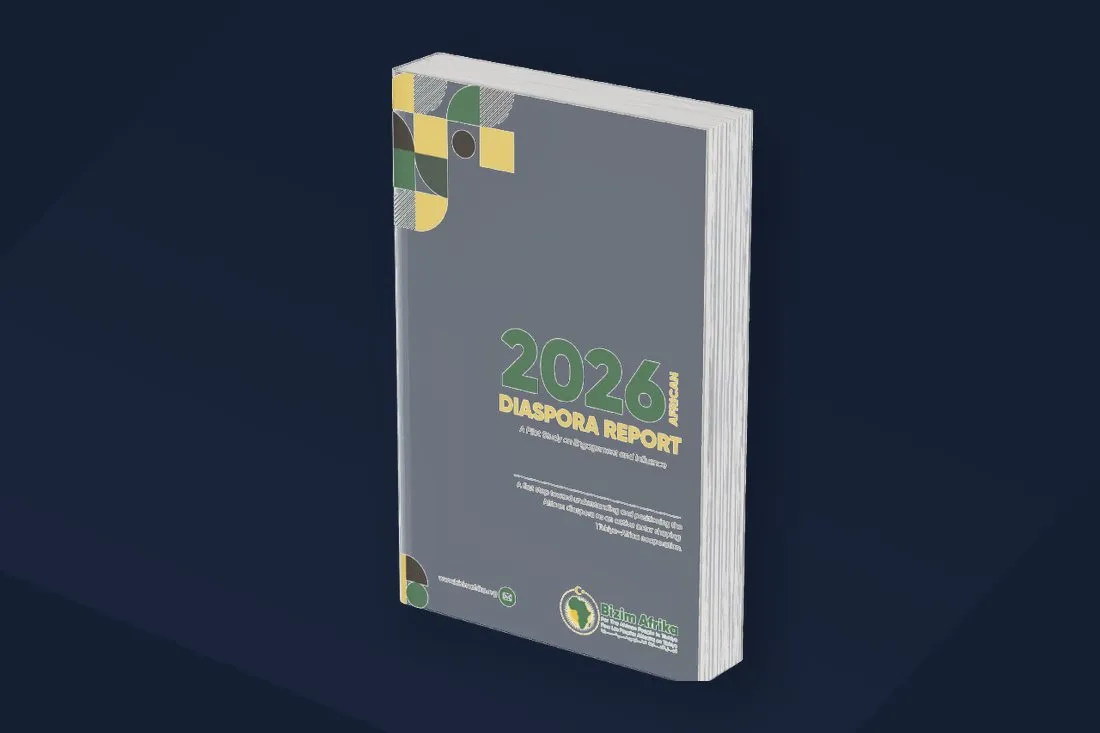
2026 African Diaspora Report
Founder & Chairman, Bizim Afrika — Project Leadership & Institutional Oversight · May 2026
A pilot study on engagement and influence — the first evidence-based account of the African diaspora in Türkiye, produced from within the community rather than about it.
Almost everything asserted about the African community in Türkiye has rested on estimate rather than evidence. Türkiye–Africa relations have expanded for two decades — trade, diplomacy, education — but the people who embody that relationship have remained largely undocumented. As the report’s foreword puts it: too often the diaspora is spoken about rather than spoken with.
The 2026 African Diaspora Report is Bizim Afrika’s first attempt to change what is on the table. Launched at the third African Diaspora Forum in May 2026, it draws on a survey of 54 respondents from 25 African countries, supplemented by qualitative interviews, and was produced by a taskforce of researchers and PhD candidates from Turkish and international institutions under editorial lead Özge Deniz Mehmetoğlu.
Its central finding is a gap between presence and influence. Respondents rated their engagement with Turkish institutions at 2.93 out of 5, and roughly two-thirds reported no participation at all in Türkiye–Africa cooperation initiatives — driven less by disinterest than by gaps in information, limited access to networks, and the absence of structured entry points. Influence is perceived as weakest precisely where the diaspora is most present: higher education. It is strongest in business and diplomatic contexts, where engagement follows existing cooperation frameworks.
The report also documents the conditions that shape everyday life — legal precarity around residence and work authorisation, economic constraint, language barriers and perceived discrimination — and argues that these compound rather than operate separately. It closes with policy recommendations on multilingual communication, residence and work pathways, economic and health stability, institutional inclusion mechanisms, professional networks, public narratives, and reciprocity within cooperation frameworks.
It is a pilot study, and says so. Its purpose is to establish a baseline and a method, not a final account — a first step towards the diaspora being understood as an active actor in Türkiye–Africa relations rather than a demographic outcome of them.